
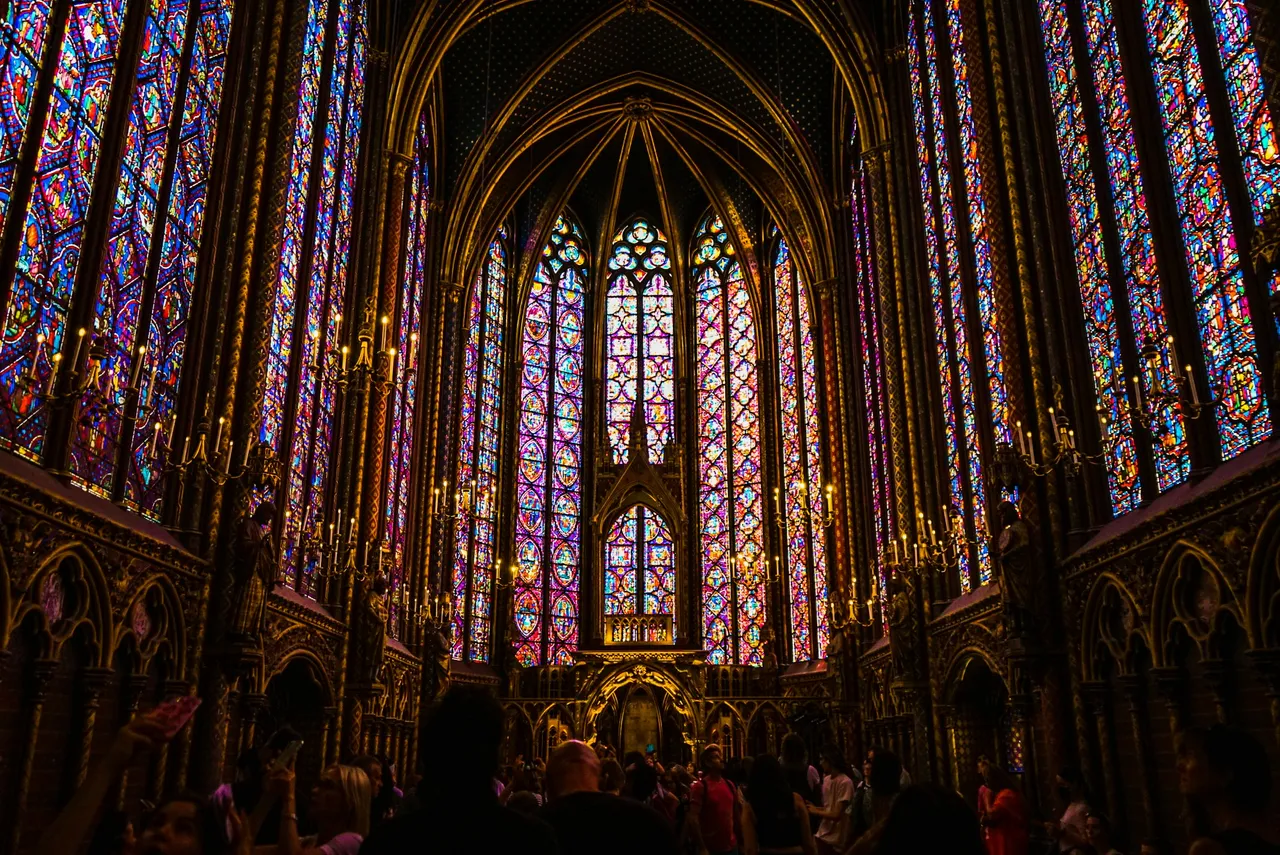
Why Sainte-Chapelle was built
Louis IX commissioned Sainte-Chapelle in the thirteenth century as part of the royal palace on Île de la Cité. The chapel was designed to house sacred relics and to express the political as well as religious authority of the French monarchy.
The building was completed in a remarkably short period, usually dated from 1242 to 1248. The official monument history offers a clear introduction to the chapel and its royal context.
Read the stained glass as a story
The upper chapel is surrounded by fifteen tall windows whose panels unfold biblical narratives across more than a thousand scenes. Instead of trying to identify every image, choose one bay, look from bottom to top and notice how figures, architecture and colour guide the eye.
Light changes the room throughout the day, but there is no single guaranteed “best” hour: weather, season and visitor flow all matter. The reward comes from giving your eyes time to adjust rather than rushing immediately toward the centre.
Lower chapel, upper chapel
The lower chapel once served members of the palace household. Its lower ceiling, deep colour and painted decoration create an intimate first act. The upper chapel, reserved historically for the king and court, replaces that sense of shelter with height and luminous glass.
Seeing both spaces in sequence is essential. The contrast explains the architecture more vividly than a list of measurements and makes the staircase between them part of the visit.
Plan tickets, security and access
Sainte-Chapelle stands within the Palais de Justice complex, so visitors pass through security. Allow extra time, travel without prohibited objects and confirm the current admission system before arriving. Opening times, closures, accessibility information and ticket options can change.
Use the monument’s official practical information rather than an old timetable. A timed ticket is not a reason to pack another major sight immediately afterward.
Build an Île de la Cité route
Pair the chapel with one nearby thread: the Conciergerie for the history of the former royal palace and Revolution-era prison, Notre-Dame and its surroundings for the island’s religious centre, or the quays for a slower view of the Seine.
Keep the route compact and leave room to look back at the exterior. For a broader Paris day, continue with our five-day itinerary or explore the city by season in summer in Paris.
More perspectives on Paris, a Tiplr Smart Destination.
About this edition
The architectural and historical core of the original story remains. Old timetables, expired concert information and promotional links were removed in favour of the monument’s current official guidance.